
Digital Transformation Readiness: Your Complete Guide for UAE Businesses
In the UAE, going digital is no longer a choice—it’s a must. National plans like the UAE Digital Government Strategy 2025, the National AI Strategy 2031, and goals to grow the digital economy’s share of non-oil GDP to around 20% by 2030 are pushing every business to adapt. As 2026 focuses on real results and execution, UAE companies need to check their readiness first. This avoids expensive mistakes and helps them take full advantage of tools like AI, cloud computing, IoT (Internet of Things), and smart systems.
TLDR: Quick Guide to Assessing Digital Transformation Readiness in the UAE
UAE businesses must prepare for digital shifts driven by national strategies like the UAE Digital Government Strategy 2025 and National AI Strategy 2031. This guide helps you evaluate readiness across six key areas: leadership/strategy, technology setup, processes/operations, people/culture, data/insights, and rules/compliance. Rate yourself on a 1-5 scale, follow a six-step assessment process (from team building to ongoing tracking), and tackle challenges like skills gaps with UAE-specific tips. Start with a self-check to align with goals like 30% productivity boosts via Industry 4.0. Benefits: Avoid costly errors, qualify for incentives, and lead in AI/cloud/IoT. Ready to assess? Focus on quick wins like cloud migration for fast ROI.
This guide gives you a clear, step-by-step way to assess how ready your business is for digital change. It builds on proven models, including those used in UAE programs like the Smart Industry Readiness Index (SIRI) for manufacturing. Focus on six main areas: strategy, technology, processes, people, data, and rules/compliance.
Why Check Your Readiness Now?
The UAE ranks high globally in AI readiness and has excellent digital basics—nearly 100% internet access, strong 5G networks, and big investments in data centers. Still, many companies, especially small and medium ones in manufacturing, construction, retail, or traditional fields, struggle with old systems, skill shortages, or scattered data.
A good readiness check helps you:
- Spot weak areas before spending big money.
- Line up with national goals, like boosting productivity by 30% through Industry 4.0.
- Show clear returns, such as ROAI (Return on AI Investment).
- Qualify for government support, partnerships, and a stronger market position.
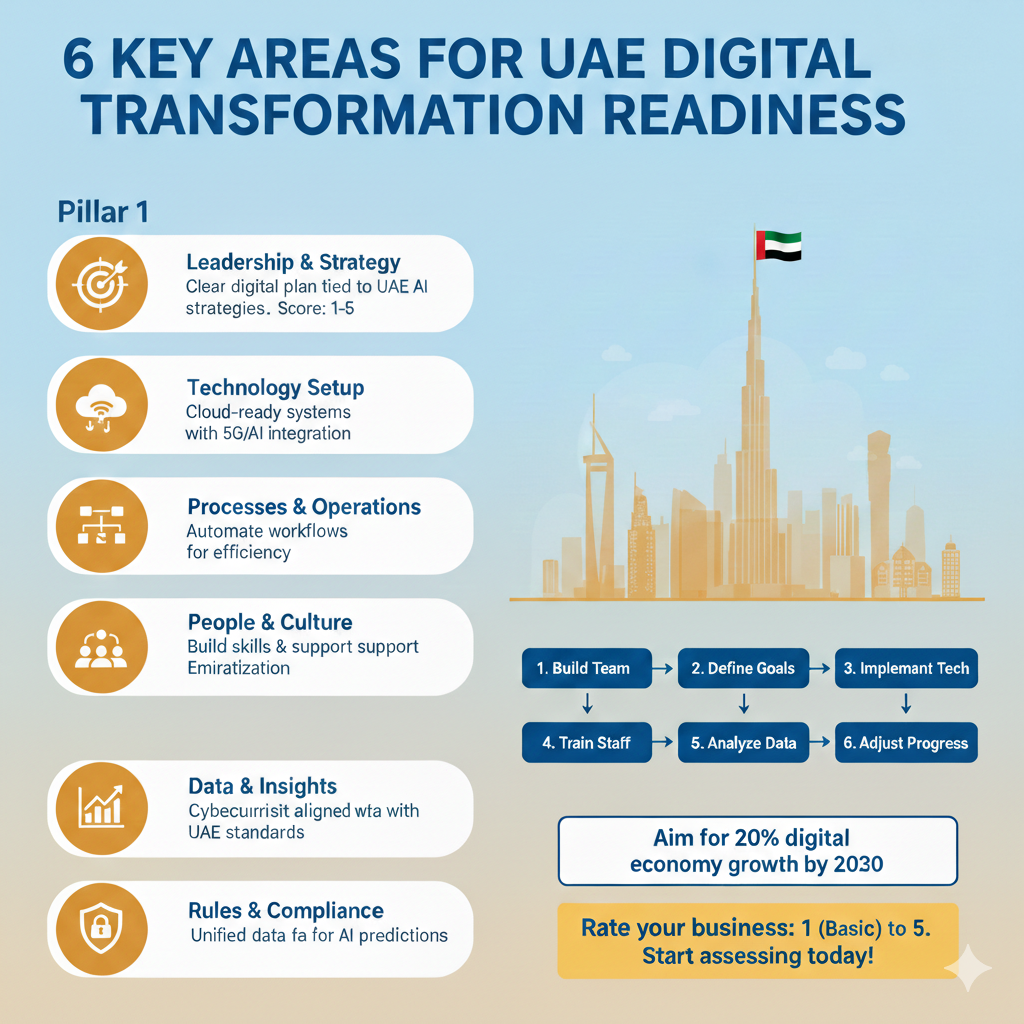
The Six Main Areas to Check
Rate your business in each area on a scale of 1 to 5:
- 1 = just starting, mostly manual
- 5 = advanced, fully using AI and data for smart decisions
- Leadership and Strategy
Do leaders have a clear digital plan linked to business goals and UAE national strategies (like using AI in healthcare, logistics, or energy)?
Do they support change, set budgets, and track results like cost cuts or happier customers?
Quick check: Does your plan support Dubai’s paperless targets or federal proactive services? - Technology Setup
Look at old systems, cloud use (like Azure or Google Cloud in the UAE), security, and ability to grow with AI or IoT.
Ask: Are your systems connected? Is everything ready for the cloud? Do you use 5G for fast, real-time work? - Processes and Daily Operations
Identify slow spots in workflows (buying supplies, supply chains, customer service).
Check how much is automated (using tools like RPA for repetitive tasks) and how digital tools improve speed. - People and Company Culture
Check digital skills across the team, training programs, and willingness to change.
In the UAE: Use this to support Emiratization (hiring and training UAE nationals) with skills in AI and digital jobs. Build a culture that welcomes new ideas and quick adjustments. - Data and Insights
Are data sources connected (no silos) or stored in one easy-to-use place?
Are you set up for AI? This means good-quality data, clear rules for using it, and tools to turn data into useful predictions and decisions. - Rules, Risks, and Compliance
Review cybersecurity, data privacy (following UAE’s National Cybersecurity Strategy), ethical AI use, and any regulatory needs (like testing in sandboxes).
Step-by-Step: How to Do Your Assessment
Follow these steps for a solid evaluation.
Step 1: Build Your Team
Bring together leaders from management, IT, operations, HR, and maybe outside experts familiar with UAE rules.
Step 2: Pick a Framework
- For manufacturing: Use the Smart Industry Readiness Index (SIRI) from MoIAT (Ministry of Industry and Advanced Technology).
- For other businesses: Adapt simple models with the six areas above.
- Make a quick survey with 5–10 questions per area.
Step 3: Gather Information
- Run surveys and interviews with staff at all levels.
- Hold workshops to map where you are now vs. where you want to be.
- Compare against other UAE companies or global examples.
Step 4: Score and See the Big Picture
Give scores (1–5) for each area. Get an overall level:
- 1–2: Basic (mostly reactive)
- 3: Growing (some tests and connections)
- 4: Strong (widely used, data-led)
- 5: Leading (AI-powered and innovative)
Step 5: Create Your Action Plan
Focus on easy wins first (like moving to the cloud), then bigger steps (like full AI use). Link everything to real returns. Look for UAE incentives, especially for SMEs in advanced industry programs.
Step 6: Put It into Action, Track Progress, and Adjust
Review every quarter. Re-check once a year or after big changes.
Common Challenges and UAE Tips
- Old systems and disconnected data → Start with a connection review.
- Lack of skills → Use UAE training programs and attract talent.
- Security worries → Follow national cybersecurity guidelines.
- High costs → Target high-return areas like AI in operations.
- Rules and regulations → Test new ideas in official sandboxes.
Final Thoughts
UAE businesses that check readiness today will lead tomorrow. With 2026 all about real execution, clear results, and people-focused AI, a solid assessment is your starting point for lasting growth. Begin with a quick self-check using the six areas above—then build from there with help if needed.
Your digital future begins with an honest look at where you stand. Ready to start?
FAQ: Common Questions on Digital Transformation Readiness for UAE Businesses
What is digital transformation readiness, and why does it matter in the UAE?
It’s checking if your business is prepared for tech changes like AI and cloud. In the UAE, it aligns with national goals like the National AI Strategy 2031, helping you boost productivity and access incentives.
How can UAE SMEs assess their digital readiness quickly?
Use the six main areas in this guide: Rate yourself 1-5, build a team, pick a framework like SIRI, and create an action plan. Start with a simple survey for fast insights.
What UAE-specific tools or programs help with digital transformation?
Leverage MoIAT’s Smart Industry Readiness Index (SIRI) for manufacturing, or government incentives for SMEs in Industry 4.0. Programs like Emiratization support AI skills training.
How do I overcome common challenges like skills shortages in Dubai?
Partner with UAE training programs, attract talent via local job boards, and focus on upskilling for Emiratization. Start small with cloud tools for quick wins.
What’s the ROI of assessing readiness?
Expect gains like 30% productivity boosts, cost savings via automation, and better alignment with UAE’s 20% digital economy target by 2030. Track ROAI for AI investments.
Is this guide relevant for industries like retail or healthcare in Abu Dhabi?
Yes—adapt the pillars to your sector. For example, use AI for personalized retail or secure data for healthcare compliance.
How often should I re-assess my business’s digital readiness?
Quarterly reviews and annual full checks keep you aligned with fast-evolving UAE tech like 5G and AI.