AI Visual Marketing UAE: Complete Business Guide (Ramadan 2026)
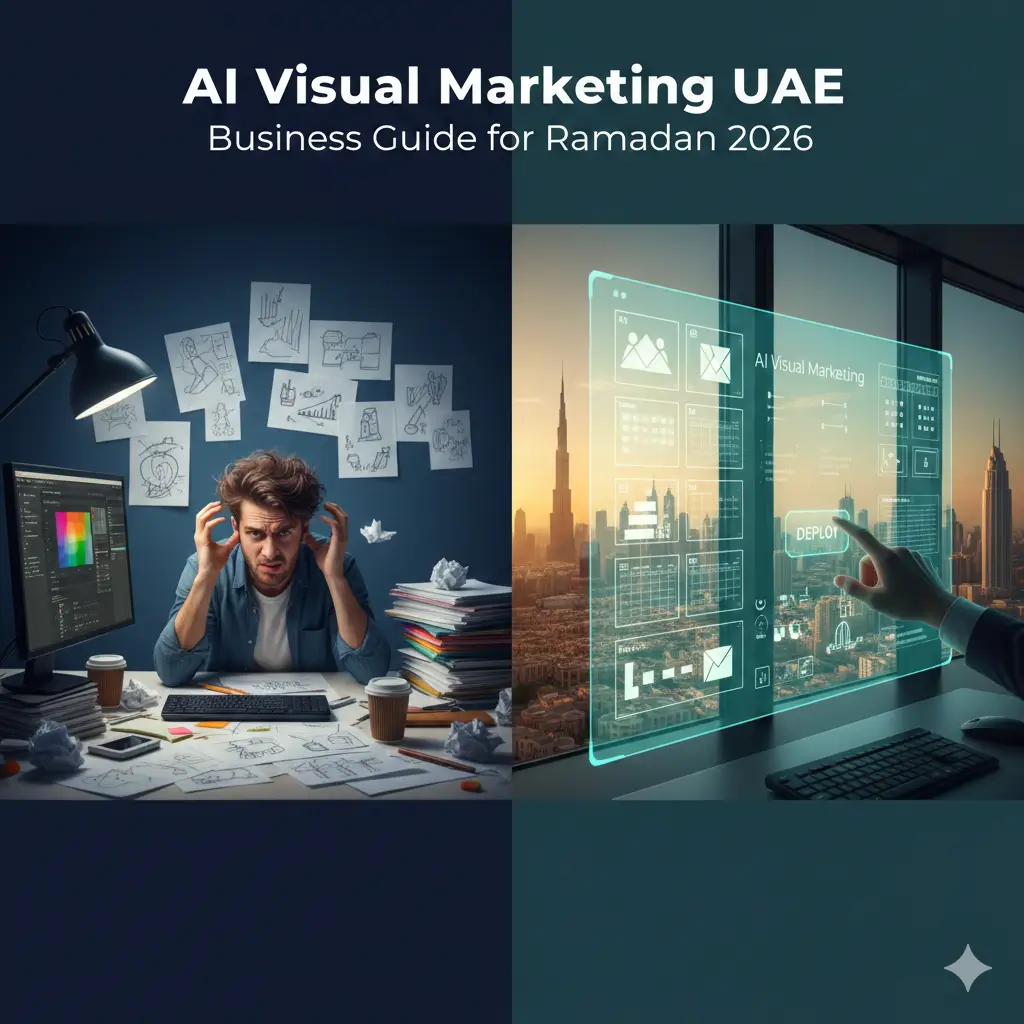
AI visual marketing helps UAE SMEs create on-brand images, posters, and short videos faster and at a lower cost, which is ideal for seasonal campaigns such as Ramadan and Eid. Google Mixboard is a visual brainstorming board in public beta, while Nano Banana (Gemini image generation and editing) is accessible via the Gemini app or Google AI Studio, with free tier limits. If you’re planning offers for Dubai, Abu Dhabi, Sharjah, or Ras Al Khaimah, it pays to start early. Current UAE forecasts suggest Ramadan may begin around 19 February 2026 and Eid al-Fitr may fall around 20 March 2026, but both dates remain subject to the official moon sighting and announcement and can shift by a day.
Key Takeaways
- Where AI visuals fit in a UAE marketing plan, and what they should not replace
- A practical workflow using Mixboard for ideas and Nano Banana for final assets
- Prompt patterns that produce cleaner posters, menus, and social creatives
- Localisation tips for Ramadan and Eid visuals across a multicultural audience
- How to export, quality-check, and measure results with simple KPIs
What is AI Visual Marketing for UAE Businesses?
AI visual marketing is the use of AI tools to plan, generate, and edit images and short videos for everyday business needs. Think Instagram posts, WhatsApp offer creatives, website banners, menu tiles, flyers, event posters, and quick variants for paid ads. For many SMEs, the biggest win is speed: you can produce several layout options in one sitting, then pick the best and refine it.
In practice, AI can replace or reduce time spent on basic design tasks, such as drafting layouts, removing backgrounds, resizing to different platforms, generating multiple versions for different Emirates, and testing a few headline and colour combinations. It’s also helpful when you need consistency across a campaign, for example, a “Ramadan offers” set that includes a banner, a story format, and a WhatsApp image.
What it should not replace is your brand judgement. Strategy, tone, and approvals still need people, especially for visuals that represent families, attire, gestures, and bilingual Arabic and English text. Legal checks also remain important, including permission for photography, use of trademarked elements, and accuracy of prices and offers.
A simple way to place AI visuals in your wider content plan is the Content Value Pyramid many UAE teams use:
- Evergreen guides (SEO traffic): a “How to choose a clinic in Dubai” page with clean, original visuals.
- Daily updates (engagement): quick graphics for local announcements or weekend offers.
- Short videos (awareness): a 15-second Reel showing an offer or new arrival.
- Email and CRM (conversion): a clear banner in a campaign that drives bookings, calls, or WhatsApp messages.
This approach works across hospitality, retail, real estate, clinics, salons, gyms, automotive services, and professional firms because the same offer can be adapted into several formats without starting from zero each time.
When AI is the right choice, and when you still need a designer
AI is a strong fit when you need speed, you have a tight budget, and you need many variations (different headlines, languages, or formats). Typical UAE use cases include Ramadan offers, Eid greeting creatives, a new branch opening in Sharjah, a weekend promotion in Dubai Marina, or an event poster for Abu Dhabi.
A designer’s review is the safer choice when the asset is high risk or high spend, such as billboards, major paid campaigns, brand refreshes, or anything where a small mistake could damage trust. Put simply, AI can do the first 80 percent quickly, but human review protects the final 20 percent.
A simple workflow that keeps quality high and costs predictable
A repeatable workflow matters more than the tool itself. Keep it simple: start with a one-page brief (offer, dates, audience, channels, and required sizes). Build a quick moodboard in Mixboard for layout and style options. Generate first drafts, review internally, localise for Arabic and English, then export channel sizes and publish.
To avoid “random” outputs, keep a shared brand folder with your logo files, brand colours, preferred fonts, and a few reference images. Name exports consistently so your team can find them later (campaign, channel, size, date). This is the difference between quick visuals and a campaign that looks planned.
Best AI Visual Marketing Tools for UAE: Google Mixboard & Nano Banana
Mixboard is best for ideation. It behaves like a smart board where you can explore concepts, group options, upload reference images, and generate variations without committing to one final design too early. For a busy SME, that’s valuable because the slow part is often deciding what “good” looks like, not clicking export.
Nano Banana is better when you need higher-quality outputs and stronger edits. It’s designed to generate images from text, modify images using instructions, and keep a consistent style across a set. It’s also useful when your marketing needs readable text inside images, such as a price line or a clear headline on a poster. Even then, treat AI text as a draft, and proof it.
As of February 2026, Mixboard remains a public beta product and isn’t officially available in the UAE, while Nano Banana is accessed through Gemini experiences (Gemini app or Google AI Studio). Free tiers tend to have daily limits, so it helps to plan production in batches rather than generating visuals one by one throughout the week. For date planning, many businesses are working to projections reported by outlets such as a Ramadan 2026 start date report, while keeping final schedules flexible until local moon sighting announcements.
Access and setup for UAE teams (without wasting time)
Keep setup decisions boring and practical. Decide who owns the account (a founder account often becomes a bottleneck). Use a shared marketing inbox where possible, and store outputs in a shared drive with clear folders per campaign.
For approvals, agree a simple rule: no visual goes live until (1) the offer is confirmed, (2) Arabic and English text is checked by a confident reader, and (3) someone signs off the final export sizes. This matters when you’re producing versions for Dubai, Abu Dhabi, and Ras Al Khaimah at the same time, with slightly different offers or branch details.
What to ask for, prompts that produce clean, usable marketing images
A prompt that works for marketing is less about poetry and more like a mini-brief: goal + audience + offer + UAE setting + style + brand colours + space for logo + output size. Keep it direct, and state what you don’t want (busy backgrounds, tiny text, clutter).
Here are prompt examples you can adapt:
- Dubai café poster (Ramadan offer): “Square Instagram post, Dubai café Ramadan evening offer, warm lighting, neutral family-friendly scene, geometric pattern border, brand colours navy and gold, clear headline space, empty corner for logo, photorealistic, 1080×1080.”
- Abu Dhabi clinic announcement: “Clean poster for Abu Dhabi dental clinic, ‘New weekend appointments’, modern reception setting, calm palette, bilingual layout with English and Arabic text areas left blank, space for logo, 1080×1350.”
- Sharjah salon Eid promo: “Eid promotion image for Sharjah ladies salon, elegant abstract background, tasteful Arabic calligraphy as a design element (no messaging), brand colours blush and white, space for offer text, 1080×1920 story.”
- Ras Al Khaimah gym offer: “Bold fitness promo for Ras Al Khaimah gym, indoor training scene, simple background, high contrast text area, brand colours black and red, space for logo, 1200×630 website banner.”
- Real estate listing visual (Dubai): “Luxury apartment feature image, Dubai skyline in distance, neutral interior styling, clean composition, space for headline and 3 key features, no visible brand marks, 1200×630.”
If you add Arabic text into an image, treat it as a draft and proof it with a native speaker before publishing.
Making Ramadan and Eid visuals feel local, without cultural missteps
Seasonal marketing in the UAE is both an opportunity and a risk. Done well, it feels timely and respectful. Done badly, it looks generic, or worse, inaccurate. The practical approach is to plan a few weeks ahead, build a small set of templates, then localise for each audience segment.
For 2026 planning, many teams are working towards Ramadan from 19 February 2026, with Eid al Fitr projected for 20 March 2026, subject to moon sighting. Even if dates shift by a day, early planning still helps because your visuals, landing pages, and offer terms can be approved in advance.
A multicultural audience also means you often need multiple versions: Arabic-first, English-first, and sometimes a simpler “visual-only” version for WhatsApp. You can keep the same core image style and swap the headline, offer, and branch details.
Local design cues that work across Dubai, Abu Dhabi, and Sharjah
Use cues that feel regional without leaning on sensitive themes. Warm lighting, geometric motifs, and tasteful calligraphy as a visual element tend to work well. Local skylines can be included when they’re used as a background detail and not a focal point that distracts from the offer.
A short safeguard list helps:
- Do use modest, neutral styling and natural poses.
- Do check attire details and avoid odd hand gestures.
- Don’t force symbols that your audience may read as personal or sensitive.
- Don’t publish without a human cultural and language review.
Channel ready exports, sizes, captions, and a quick QA checklist
Exporting is where good visuals become usable marketing. Plan your sizes upfront: square and portrait for Instagram, story format for offers, a WhatsApp share image, a website banner, and an email header. Keep safe margins so your logo and headline don’t get cut off in previews.
Use this quick QA checklist before anything goes live:
- Text is readable on a phone screen, not just on desktop.
- Prices use the AED prefix (for example, AED 99).
- Dates follow UAE-friendly format (for example, 19 February 2026).
- Logos and key text sit inside safe margins.
- Fonts and colours match your brand folder.
- Website images include alt text for accessibility.
- Arabic copy is proofed by a confident reader.
How to publish, measure results, and turn visuals into leads
Once you have a small visual set, publish where your customers already look. For many UAE SMEs that means Google Business Profile, Instagram, LinkedIn (especially for B2B services), your website, email, and WhatsApp broadcasts. The same core visual can be resized and lightly reworded for each channel, which keeps your brand consistent and saves time.
Measurement doesn’t need complex dashboards. Pick a few KPIs you can actually track week to week: saves and shares (quality signal), link clicks to offers, WhatsApp enquiries, booking messages, and page visits to your offer or contact page. AI visuals are especially useful for quick A B tests, such as two different headlines on the same image style, or two different background choices for the same offer.
If you want a second source for date projections to plan production calendars, you may see coverage like this UAE Ramadan 2026 projection. Keep your final posting schedule flexible until local announcements confirm dates.
Where UAEThrive fits, visibility, trust, and local discovery
Strong visuals bring attention, but listings and profiles convert that attention into action. When your brand colours, photos, and offer graphics match across channels, customers feel they’re dealing with a real business, not a one-off post. That consistency supports discovery in search and map results, and it increases the chance of calls, messages, and direction requests.
A simple weekly routine for SMEs (30 to 60 minutes)
Set one weekly slot to keep the system running. Spend 10 minutes choosing three offers or topics, 20 minutes generating and refining two visual options per offer, then 10 minutes exporting sizes. Use the remaining time to schedule posts and drop one visual into email or WhatsApp.
This also maps neatly to the Content Value Pyramid: one campaign idea can become a short video, two social posts, and an email banner, then later it can be reused in an evergreen guide on your website.
Conclusion
AI visual marketing gives UAE businesses a practical way to produce faster campaign visuals, keep branding consistent, and localise offers for different audiences and Emirates. Mixboard can help your team agree on a direction quickly, while Nano Banana can produce cleaner final images and edits, as long as you keep a human approval step. Plan early for key dates, keep exports consistent, and track a few KPIs that tie back to enquiries and bookings. If you want more local discovery alongside your new visuals, start with a complete UAE business listing.
https://uaethrive.com/get-your-uae-business-discovered-for-free
