Fresh UAE Market Insights
Stay ahead of daily shifts in UAE business, from Dubai trade flows to Ajman property and Sharjah culture. Use these insights to plan smarter moves for your SME or investment portfolio.
View UAE Market Insights
The UAE news today on 15 December 2025 brings a mix of growth stories, safety updates, and long‑term projects that affect where we work, invest, and live. We focus on verified developments that matter to business owners, professionals, investors, and residents in every Emirate.
Listen to our audio summary above for key insights from UAE News Today — Top Stories & Updates | 15 December 2025.
We group today’s update into four themes: economic and business climate, society and regulation, culture and tourism, plus infrastructure, weather, and future readiness. Each section highlights what the news means in real terms, from SME strategy to household planning.
In the background, recent federal legal reforms and humanitarian airbridge support to Sri Lanka show the UAE tightening protections while continuing its regional aid role. Our focus here stays on what has changed or moved today, and how we can respond as a community of decision‑makers.
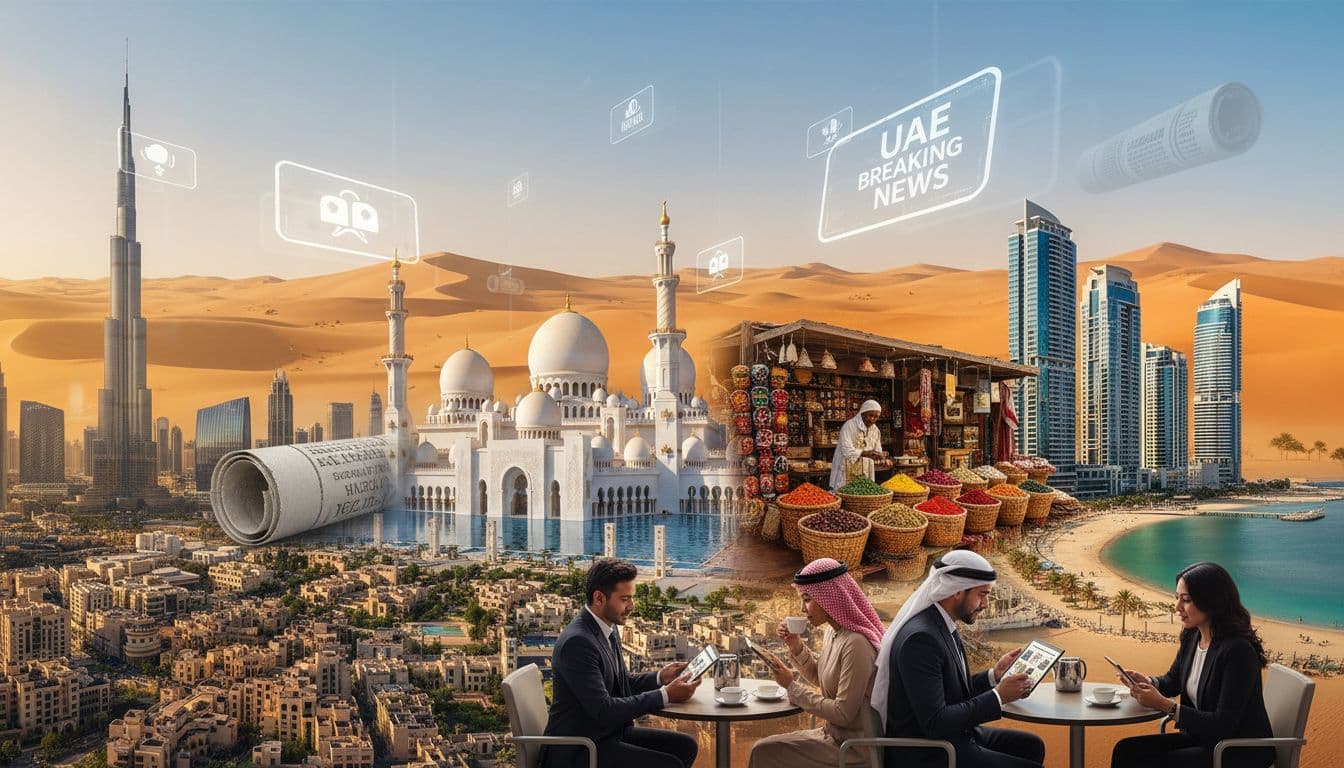
Daily UAE business and society updates across all Emirates. Image created with AI.
Business activity across Dubai and the northern Emirates continues to build momentum. For many of us running SMEs or planning a move into the market, the key question is simple: where is real demand growing, and how should we position our companies?
Today’s figures and project updates give clear signals in three areas: cross‑border trade and services in Dubai, real estate activity in Ajman, and the UAE’s role in global crypto and tokenisation.
Dubai Chamber has confirmed that 13,851 Indian‑owned companies registered as members in the first nine months of 2025, a year‑on‑year rise of around 13.9 per cent. India remains the top non‑UAE member base, which reflects how deep the India–Dubai business corridor has become.
Most of these new firms sit in wholesale and retail trade, real estate and business services, construction, and transport or storage. That means more competition in classic Dubai sectors, but also more partners to work with if we serve these supply chains.
Other nationalities are also expanding their presence. Companies from Pakistan, Egypt, Bangladesh, the United Kingdom, and several other markets are growing membership too. For day‑to‑day life in Dubai, this mix translates into a broader service base, more specialist consultancies, and a wider hiring pool.
For SMEs and new founders, a few clear moves stand out:
If we treat this data as a market map, it becomes easier to choose where to double down and where to avoid crowded ground.
Ajman’s real estate sector is having a strong moment. In November, the Emirate recorded about AED 2.42 billion in property transactions, up roughly 32 per cent compared with the same month last year. There were more than 1,500 deals, plus a solid block of mortgages.
Areas such as Emirates City, City Towers, Ajman One, and Helio 2 are among the most traded communities. For buyers, this level of activity often signals firmer prices and more interest from both residents and investors. For landlords, it hints at stronger rental potential as new residents move into these clusters.
On the construction side, work at Ajman Uptown has hit another milestone, with concrete works reported as complete. This is one more sign that large community projects in Ajman are moving ahead steadily, rather than sitting on plans alone.
For those active in property and related services:
New rankings from Bybit and DL Research place the UAE 5th globally, and first in the MENA region, for crypto adoption. The report highlights the country as a tokenisation hub that links Asia, Europe, and Africa, supported by clear anti‑money‑laundering rules and a fast‑growing user base.
In plain terms, tokenisation just means turning real‑world assets, such as property or funds, into digital tokens that can be traded or used in new ways. Combined with strong regulation, this gives both users and institutions more confidence that activity will sit inside clear rules rather than on the edges.
For SMEs, crypto does not have to be part of daily operations, but it can be relevant in a few cases:
At the same time, fraud risks remain real. Fake tokens, Ponzi‑style schemes, and social‑engineering scams target both individuals and businesses. This is where today’s Dubai economic security campaign, covered later, links closely with the country’s tech leadership. The message is simple: use licensed platforms, follow local rules, and treat “too good to be true” offers with real caution.
Regulation and enforcement news can feel dry, yet these decisions shape how we hire staff, manage fleets, and protect family budgets. Today’s updates show a clear trend: stronger protection for residents and sharper expectations for employers and service providers.
We look at domestic worker recruitment rules, traffic compliance in Sharjah, and a wide fraud awareness push in Dubai.
The Ministry of Human Resources and Emiratisation (MoHRE) has now approved 311 licensed offices across the UAE to recruit and manage domestic workers. These are the only offices that families should use when hiring nannies, drivers, housekeepers, or similar home help.
MoHRE is also cracking down on illegal recruiters, including unlicensed offices and social media accounts that operate outside the Domestic Workers Law. Violators face fines and possible referral to Public Prosecution.
For households, using a licensed office brings several benefits:
For recruitment agencies, PRO firms, and business service centres, the bar has moved higher. Licensing, compliance checks, and transparent pricing are becoming core parts of the offer, not optional extras.
As residents and employers, we can protect ourselves by checking that an office is licensed, keeping copies of all agreements, and avoiding informal deals started by direct messages on social platforms.
Sharjah Police have recorded more than 30,000 violations of the dedicated lane law since it came into force on 1 November. The rule sets out which lanes heavy vehicles, buses, delivery bikes, and motorcycles should use on key roads. Drivers who ignore it face steep fines and black points.
For riders and company fleets, these are not just traffic numbers. Repeated violations can raise operating costs, put licences at risk, and increase accident chances. For a delivery platform or SME with a small fleet, that can quickly become a real business problem.
Practical steps that companies can take include:
A structured approach keeps costs under control and supports safer roads for everyone.
Dubai has launched a national awareness campaign, “Strong Economy, An Aware Society”, led by the Dubai Center for Economic Security. The campaign targets deepfakes, fake links, phishing, misleading adverts, crypto scams, and fraudulent investment offers that can hit both individuals and companies. Full details are available in the official Dubai Media Office announcement.
This drive sits side by side with the Dubai Cashless Strategy, which aims for most payments in the Emirate to be digital by 2026. As we move towards near‑universal online and card payments, the cost of falling for a fake link or voice clone attack gets higher.
For residents, a few habits go a long way:
For SMEs and retailers, the campaign is a reminder to upgrade internal defence:
In a cashless economy, financial safety becomes a core part of brand trust, not just an IT issue.
While business headlines focus on numbers, culture and education investments often shape the next decade of growth. Today, Sharjah and Abu Dhabi stand out, with Dubai adding lifestyle trends that signal where resident demand is heading.
Together, these stories create new space for partnerships, talent development, tourism packages, and specialist services.
Sharjah’s Ruler has announced the creation of the University of the Arts Sharjah and appointed Sheikha Hoor bint Sultan Al Qasimi as president. The new university will bring together higher education in arts and performing arts under one institution, supported by new leadership for the visual and performing arts academies.
For students, this means more local options to study fine art, design, performance, and related fields without leaving the country. For creative businesses in media, design, architecture, gaming, and events, it signals a stronger pipeline of trained talent and more internships or collaboration projects.
At the same time, Sharjah’s Faya archaeological site has joined the UNESCO World Heritage List. The site records early human settlement in the region from roughly 210,000 to 10,000 years ago and is managed and protected by the Sharjah Archaeology Authority. This adds another serious heritage asset to the Emirate’s cultural map.
Tour operators, schools, and creative agencies can respond in several ways:
Culture here is not just “nice to have”; it becomes real economic activity.
Looking ahead to April 2026, the 23rd Abu Dhabi Festival will run under the theme “The Wisdom of Culture”, bringing more than 1,000 artists from 19 countries, with the United States as Country of Honour. It marks 30 years of the Abu Dhabi Music & Arts Foundation and includes orchestras, ballet, opera, concerts, and an “Abu Dhabi Festival Abroad” strand. We unpack the festival in depth in our feature on the Abu Dhabi Festival 2026 cultural agenda.
This event sits inside a busy winter season that also covers Global Village, Dubai Shopping Festival, Liwa Festival, Yas Island shows, Expo City events, mountain getaways in Hatta and Ras Al Khaimah, and more.
For hotels, restaurants, transport firms, and creative agencies, the message is simple: cultural calendars are now business calendars.
Concrete actions could include:
Lifestyle trends often seem minor, yet they reveal what residents are willing to pay extra for. In Dubai, pet‑friendly communities are gaining ground, with JLT’s playful “Chief Dog Officer” symbolising how seriously some developers now treat dog‑owning residents.
Dog parks, pet‑friendly cafés, and even hotels welcoming animals are becoming real selling points for certain neighbourhoods. For landlords, developers, and F&B brands, clear pet policies and occasional dog‑focused events can set one building or venue apart from the next.
On the wellness side, Dubai will host its first dedicated Pilates festival, Form Fest, in February 2026. The event will bring international and local instructors together for reformer and mat classes, workshops, and panels, with a day pass starting at AED 1,650, which shows that this is a premium niche.
Studios, wellness brands, and retail groups can tap into this shift through:
Transport lines, community facilities, and even rain patterns all shape how we plan operations and where we choose to live or invest. Today’s updates touch Dubai’s long‑term metro expansion, a landmark mosque on Palm Jebel Ali, and near‑term weather and resource‑management news from Abu Dhabi.
The Dubai Metro Blue Line is now about 10 per cent complete and targeted for full operation in 2029. It will run along two main routes, around 21 km and 9 km, and is expected to serve about one million people. Planned stations will connect Academic City, Al Jaddaf, Al Rashidiya, Al Warqa, Dubai Creek Harbour, Dubai Festival City, Dubai Silicon Oasis, and three stops in International City, as well as Dubai International Airport.
City planners expect the line to cut road congestion by around 20 per cent once complete. For many of us, that could mean shorter commutes, less need for a second car, and a wider choice of areas where it makes sense to live or open an office.
On the coast, Nakheel has revealed the design for a major Friday Mosque on Palm Jebel Ali, created by architecture firm SOM. The mosque will feature a 40‑metre minaret, a textile‑like canopy, carefully filtered natural light, and capacity for around 1,000 worshippers. It is planned as a spiritual and cultural centrepiece for the island.
For SMEs, investors, and real‑estate professionals, practical tips include:
The National Centre of Meteorology has forecast light to moderate rain across parts of the UAE over the coming days, with showers moving from western areas towards Abu Dhabi, then on to northern and eastern regions. Winds may strengthen at times, raising dust and roughening the Arabian Gulf and Sea of Oman, as detailed in the official WAM weather update.
For residents and businesses, this means planning around slower traffic, reduced visibility, and possible delays for outdoor events and construction works. Basic steps, such as adjusting delivery schedules, allowing more travel time, and checking vehicle and site safety, can reduce disruption.
In Abu Dhabi’s farming areas, the Department of Energy and ADAFSA have started rolling out AI‑enabled smart water metres, beginning in Al Wathba. The metres connect to the AD.WE digital platform to track water use in real time, reducing waste and supporting more efficient irrigation.
For farm owners and agribusinesses, this is a strong signal that data‑driven resource management is becoming standard. For tech suppliers, it points to growing demand for smart‑agri solutions. Even city‑based readers benefit in the long run, as better water use in agriculture supports food security and sustainability targets.
The 15 December 2025 news cycle shows a country combining strong business growth with tighter protections and rich cultural planning. We see Dubai deepening its international business base, Ajman building momentum in real estate, and the UAE ranking among the world’s leaders in crypto adoption.
At the same time, MoHRE’s domestic worker rules, Sharjah’s lane enforcement, and Dubai’s fraud awareness drive all push towards a safer, more accountable daily life. Sharjah’s arts university and UNESCO site, Abu Dhabi’s festival plans, Dubai’s metro expansion, and Abu Dhabi’s smart water metres reveal how culture and infrastructure shape where we will study, work, and invest in the years ahead.
When we stay informed, we make better choices about our own companies, careers, and families. If we run a business in the UAE, this is the right moment to review our visibility, compliance, and growth plans for 2026. To reach more local customers and build trust, we can get our UAE business discovered for free on UAEThrive and turn today’s insights into real opportunities.
Stay ahead of daily shifts in UAE business, from Dubai trade flows to Ajman property and Sharjah culture. Use these insights to plan smarter moves for your SME or investment portfolio.
View UAE Market InsightsPut your company in front of residents and decision‑makers searching across all seven Emirates. Create your free UAEThrive listing and start collecting local leads and enquiries.
Claim Free Business ListingCompete in busy markets like Dubai, Sharjah, and Ajman with priority placement and richer profiles. Our Premium Listing Package helps serious buyers find and trust your brand faster.
Explore Premium VisibilityUnsure how to use today’s UAE news to grow your business in 2026. Book a free call and we will help you map visibility, compliance, and lead‑generation steps for your sector.
Book Growth Strategy Call