UAE Market Insights
Track the signals behind the headlines, from retail demand to mobility and infrastructure spend. Use the insights to plan offers, staffing, and budgets with more confidence.

What’s the UAE news today that actually changes how we run our businesses on 24 December 2025?
With year-end trading, travel peaks, and packed events calendars, even “background” updates can affect operations. Reliability works can bchange delivery routes, health service upgrades can reduce time-off for appointments, and retail campaigns can shift demand overnight.
Listen to our audio summary above for key insights from UAE News Today — Top Stories & Updates | 24 December 2025.
In this daily round-up, we focus on practical takeaways for SMEs and professionals across Dubai, Abu Dhabi, Sharjah, and the Northern Emirates. We’ll cover what might change tomorrow (traffic, fog, footfall), what to watch this week (DSF shopping patterns, event congestion), and simple actions we can take now to protect budgets, staffing plans, customer experience, and risk registers.
For local suppliers and service firms, visibility matters too. Keeping your details accurate and easy to find is part of operational resilience, just like backup plans.
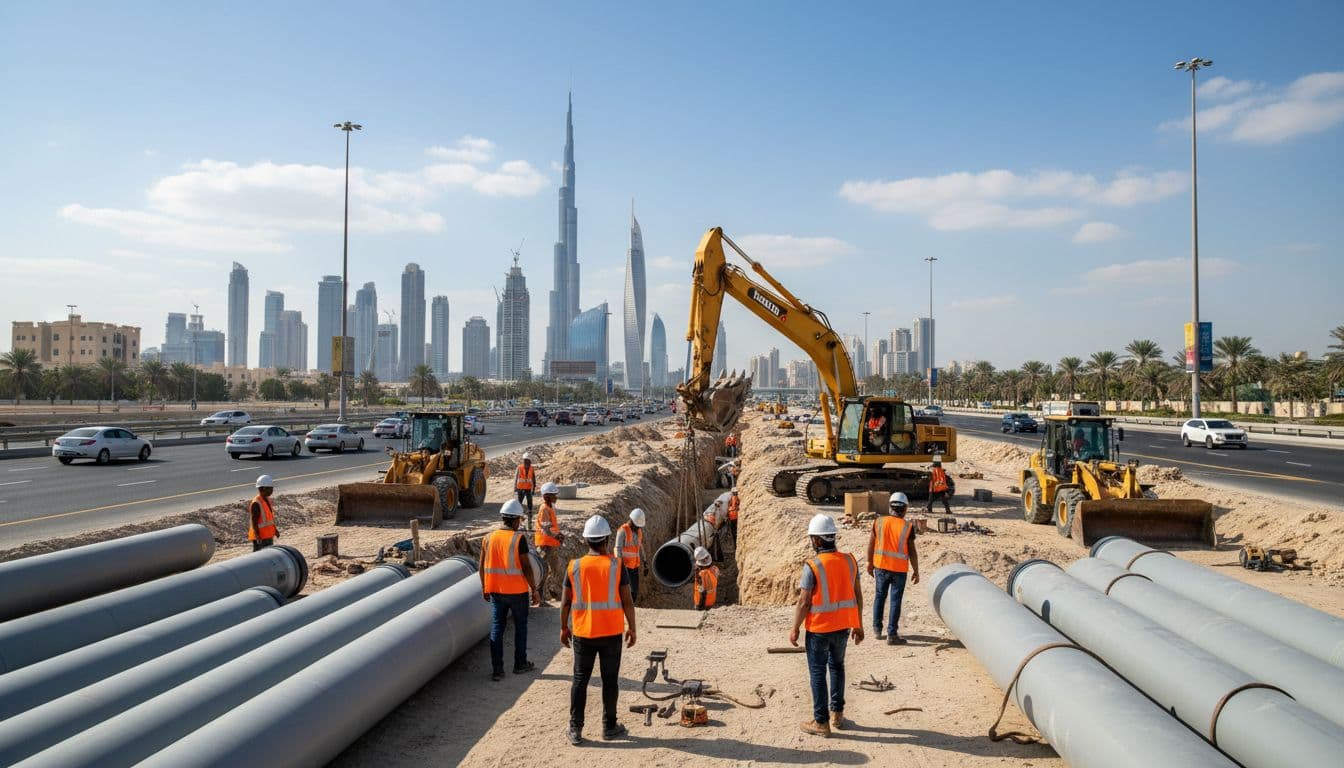 A Dubai-style utilities construction scene with pipeline installation and traffic nearby, created with AI.
Dubai’s growth needs infrastructure that keeps pace. A key update today is DEWA’s awarded contract (shared via an official Dubai government communications channel) worth AED 100.8M. The work covers the supply, installation, testing, and commissioning of glass-reinforced epoxy (GRE) water pipelines and related works across 20 locations in Dubai, delivered over 24 months.
For residents, the headline is simple: fewer service interruptions and a stronger network. For businesses, it’s about reliability. Water-network works can be disruptive, but planned protection and diversion of existing services reduces the risk of unexpected outages during construction phases.
If we run a café, salon, clinic, warehouse, or any service that depends on steady utilities, reliability is like rent. We only notice it when it’s missing. For background context on DEWA and its services, we can refer to the official DEWA website at https://www.dewa.gov.ae/en/.
From a business continuity angle, the smart move is to assume there will be phased works and multiple site touchpoints. The upside is improved resilience, but we still need to manage the practical day-to-day.
A helpful habit is to treat utilities works like a planned peak season: we prepare, communicate early, and keep options open.
If customers are searching for nearby services while routes shift, it also helps to be easy to discover by area and category. That’s where our own listing hygiene matters, and we can check how we appear in the UAE business directory listings so customers can find us even when they’re changing plans.
Because the project spans 20 locations, we should expect impacts that feel “small” but add up: short-term lane changes, restricted access at certain times, temporary parking changes, and contractor activity that affects loading bays.
We don’t need to guess dates or exact streets. We can plan in a sensible, low-drama way:
Facilities teams can confirm access points and update site maps. Retail and F&B teams can shift delivery windows away from busy hours. Service businesses (repairs, home visits, on-site support) can build travel buffers and confirm appointments on the day.
The main idea is to avoid surprises. A 20-minute delay doesn’t sound like much until it hits three jobs in a row and the last customer cancels. Planning for friction is part of keeping revenue steady.
It also helps to re-check supplier service level agreements (SLAs). If delivery times are tight, we can request flexible slots during works periods, or set a “best effort” expectation with customers so trust doesn’t take a hit.
Today’s health-related updates matter for employers because healthcare access affects attendance, productivity, and staff confidence.
First, Sheikh Hamdan bin Mohammed reviewed Dubai Health achievements and initiatives linked to an integrated academic health system, with practical themes that include digital care, community programmes, improved access, home care, and telemedicine. There is also emphasis on services that support seniors and people of determination.
Second, Abu Dhabi’s health sector received a strong reputational signal: eight Abu Dhabi hospitals were listed among Newsweek’s Best Specialised Hospitals Middle East 2026, with Cleveland Clinic Abu Dhabi ranked highly across multiple specialties (as reported via an official UAE news service summary). For employers, rankings aren’t just a headline. They can influence how confident staff feel about local specialist care and where insurers and provider networks focus attention.
If we manage teams across Dubai and Abu Dhabi, the practical takeaway is that health access and quality remain a strategic priority, which supports workforce stability.
When healthcare shifts closer to home and becomes easier to access, we often see a simple business benefit: less time lost to travel and waiting. Digital consultations and home care can mean quicker check-ins for ongoing conditions, follow-ups without taking half a day off, and easier support for family members who need care.
For employers, that can translate into more predictable schedules. It also supports caregivers in the workforce, including staff supporting elderly parents or relatives.
From a policy point of view, we can respond in a practical way:
Inclusive services matter too. When health systems cater well for seniors and people of determination, it reduces stress on families and improves day-to-day wellbeing. That shows up at work in the form of steadier attendance and fewer last-minute emergencies.
Hospital rankings won’t change tomorrow’s opening hours, but they can shape confidence over time. For Abu Dhabi-based firms, strong regional rankings support the idea that specialist care can be accessed locally, which can reduce the need for overseas referrals in some cases.
For insurers and HR teams, it can influence network discussions, provider options, and staff expectations. For the wider economy, it supports Abu Dhabi’s standing in healthcare, which feeds into medical tourism confidence and related sectors such as hospitality, transport, and patient services.
Three practical ideas we can apply as SMEs:
If we want a steady stream of local, UAE-relevant updates like this, it helps to keep an eye on our UAEThrive business blog where we summarise business-impact news in plain language.
End-of-year trading in the UAE can feel like a busy roundabout. Footfall rises, customers compare prices fast, and expectations go up.
Three commercial signals stand out today:
This mix tells us something: customers are price-aware, retailers are sharpening execution, and some input costs can move fast.
DSF is great for demand, but it can punish sloppy planning. When customers see 25% to 75% discount messaging across the city, they expect clarity and speed. If we respond by discounting everything, we can end up busy but not profitable.
A healthier approach is to design offers like a menu, not a fire sale:
A short DSF checklist we can use this week:
The goal is to ride the wave without letting it pull us under.
Sharjah Coop’s move towards AI-led retail planning is a signal for suppliers across Sharjah, Ajman, Umm Al Quwain, and beyond. When a retailer uses tools to predict demand and optimise shelf layouts, it usually leads to fewer “empty shelf” moments, more consistent product placement, and faster decisions on what stays and what goes.
In plain terms, it can mean:
For suppliers, the takeaways are practical:
Cleaner product data: barcodes, pack sizes, case quantities, and images need to be accurate.
Faster replenishment: if the system flags low stock earlier, late deliveries stand out more.
Sharper promo planning: retailers will expect forecasts, not guesses.
Clear reporting: performance data may become more frequent, which is useful if we respond quickly.
It’s a reminder that retail competition isn’t only about price. Execution is the new battleground.
Today’s “planning” items are less flashy, but they’re the ones that save time and money when things get busy.
The National Centre of Meteorology (NCM) forecast (shared via the UAE’s official news service) points to generally clear to partly cloudy conditions, with a chance of light rain in coastal and northern areas, and possible fog or light fog overnight and early morning. Winds may become occasionally active, with seas slight to moderate.
For logistics, that’s enough to justify small changes to tomorrow’s schedules. For event-led businesses, it affects outdoor footfall and travel timing.
We’re also watching a cluster of end-of-year and early-2026 activity:
For the weather source item, we can refer to the official UAE news service page: https://www.wam.ae/en/article/bndiesg-ncm-forecasts-clear-weather-tomorrow-with-chance.
Fog is like an unseen speed bump. It slows everything, even when the roads look normal on the map.
If we have drivers, technicians, or deliveries moving early, we can:
For customer experience, a short message helps: “We’re on the way, travel may be slower this morning.” It prevents frustration before it starts.
Large events create two kinds of opportunity. Immediate sales (rooms, rides, meals), and longer-term partnerships (supplier deals, sponsorship, recurring contracts).
With the World Sports Summit running 29 to 30 December in Dubai, we can consider:
Hospitality and F&B: set set-menus, pre-booked group offers, and quick invoice payment options.
Transport and logistics: confirm drop-off points, driver shifts, and customer support lines for peak windows.
Media and marketing: build a simple “event week” content plan and highlight relevant services.
Business services: offer short on-site support packages (printing, staffing, translation, last-minute procurement).
Hatta’s festival entrepreneurship stories are a reminder that community commerce is real demand, not a side show. Pop-ups, weekend packages, and local partnerships can create steady revenue for micro-businesses and family-run brands.
On talent, the GCC-Stat award for ages 18 to 34 is a prompt for us as employers. If we want stronger reporting and better decisions in 2026, we should hire and train for data literacy, even in non-technical roles.
Today’s UAE news today 24 December 2025 gives us clear, practical signals. DEWA’s resilience works in Dubai point to stronger service reliability over time, but we should plan calmly for phased, local disruption. Dubai Health’s focus on digital access and home care supports workforce stability, while Abu Dhabi’s hospital recognition strengthens confidence in specialist care.
On the commercial side, DSF promotions (25% to 75%) mean higher demand and tougher competition, Sharjah’s smart retail shift raises the bar for suppliers, and the weather forecast suggests small changes to route and schedule planning. Add event momentum heading into 29 to 30 December, and it’s a week where preparation pays.
If we want more customers to find us by emirate and service when demand spikes, we can add our business for free on UAEThrive: https://uaethrive.com/get-your-uae-business-discovered-for-free.
Track the signals behind the headlines, from retail demand to mobility and infrastructure spend. Use the insights to plan offers, staffing, and budgets with more confidence.
When footfall shifts and customers search by area, being easy to find matters. Add your UAE business to UAEThrive in minutes and keep your details accurate.
Stand out during busy periods like DSF, event weekends, and peak travel days. Get stronger placement, richer profiles, and more trust signals for new customers.
Want a simple plan for visibility, leads, and local SEO in Dubai, Abu Dhabi, or Sharjah? Book a quick call and we’ll help you choose the right next step.